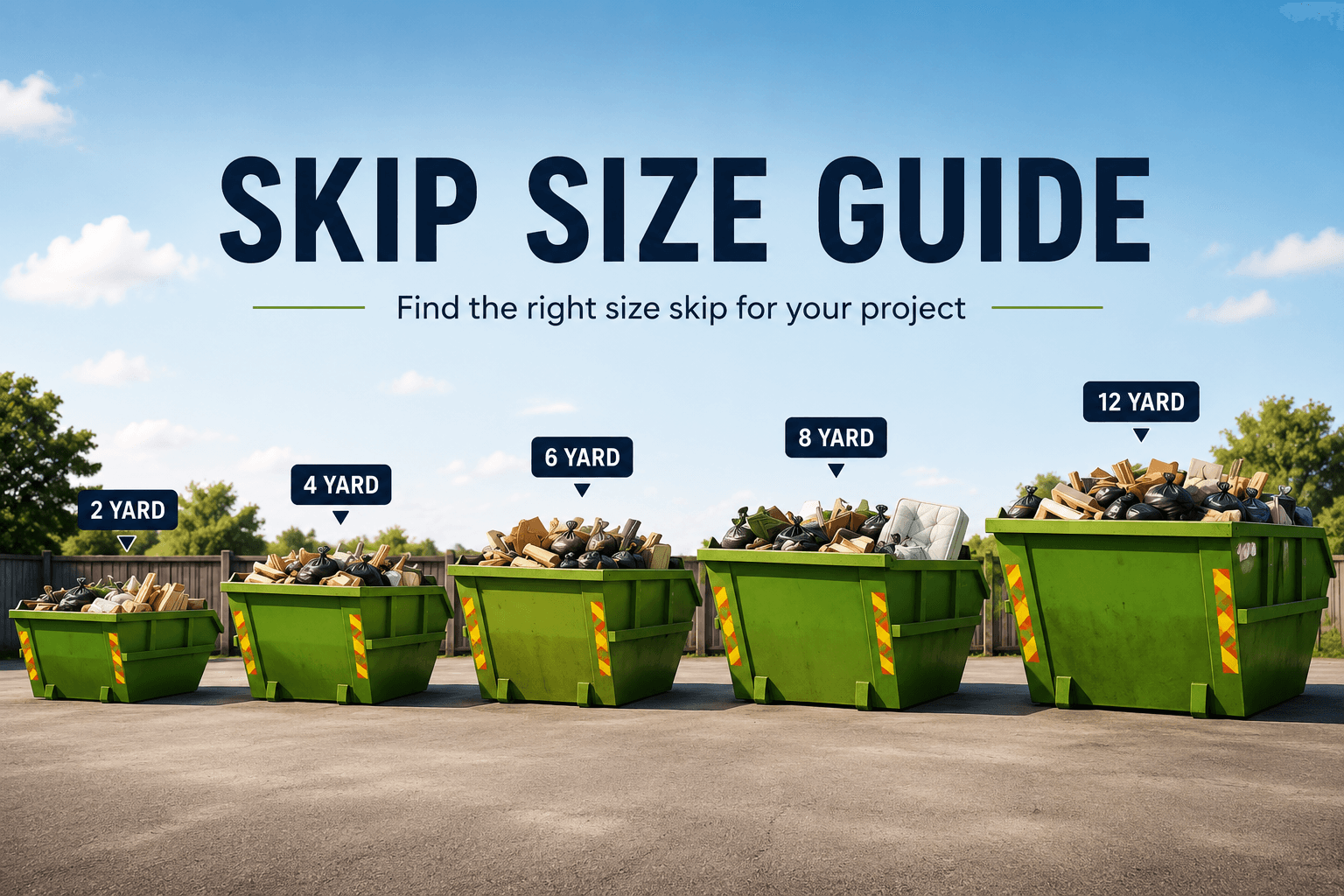
Skip Size Guide UK: What Size Skip Do You Need?
14 May 2026
Last updated: May 2026 Reading time: 8 minutes
Choosing the correct skip size can save you money, avoid overloading problems and stop you from needing a second skip halfway through your project.
In this complete UK skip size guide, we explain:
common skip sizes and dimensions
what each skip size is best for
how much waste each skip holds
skip bag and wheelie bin equivalents
which skip size suits different DIY and renovation projects
common mistakes people make when hiring skips
Whether you are renovating a bathroom, clearing a house or disposing of builders waste, this guide will help you choose the right skip first time.
New to skip hire? Before choosing a skip size, you may also want to read our Complete Skip Hire Guide, which explains permits, costs, prohibited items, skip placement rules and alternatives to skip hire.
Quick Summary
4 yard skips are ideal for small DIY projects and bathroom renovations
6 yard builders skips are the UK’s most popular skip size
8 yard skips are best for major renovations and house clearances
12 yard skips are mainly used for commercial or bulky lightweight waste
Heavy waste such as rubble and soil can exceed skip weight limits quickly
If unsure, it is usually safer to size slightly larger
Table of Contents
Skip Size Comparison Table
Skip Size | Dimensions | Bin Bag Equivalent | Best For |
|---|---|---|---|
2 Yard Mini Skip | H: 0.9m, L: 1.2m, W: 1m | 20–30 bags | Small DIY jobs, garden waste, soil and rubble |
4 Yard Midi Skip | H: 1m, L: 1.8m, W: 1.3m | 30–40 bags | Bikes, small fridges, TVs, small sofas and chairs |
6 Yard Builders Skip | H: 1.2m, L: 2.6m, W: 1.5m | 40–55 bags | Kitchen, bathroom and home renovations |
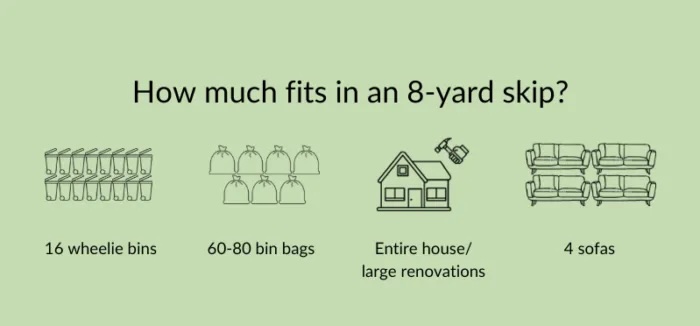
8 Yard Builders Skip | H: 1.2m, L: 3.7m, W: 1.7m | 60–80 bags | Full house clearances and major renovation work |
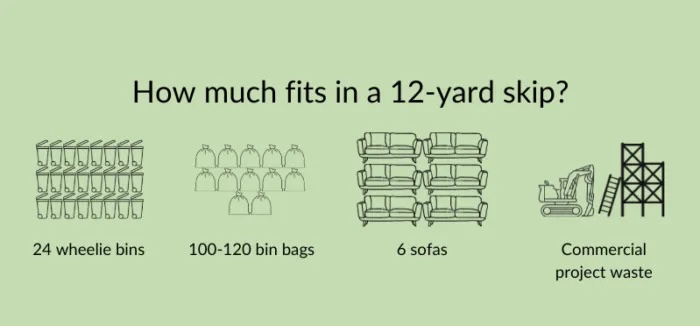
12 Yard Maxi Skip | H: 1.7m, L: 3.7m, W: 1.8m | 100–120 bags | Very large projects and, general construction waste |
Heavy materials such as rubble, concrete and soil can exceed skip weight limits quickly, even when the skip is not full.
What Do Skip Sizes Mean?
Skip sizes are measured in cubic yards.
One cubic yard is approximately:
10 standard bin bags
0.76 cubic metres
The larger the cubic yard size, the more waste the skip can hold.
However, capacity is not only about volume. Heavy materials such as:
rubble
concrete
bricks
soil
can quickly exceed skip weight limits even when the skip is only partly full.
For a detailed breakdown of skip weight restrictions, read our Skip Weight Limit Guide.
2 Yard Mini Skip
A 2 yard skip is also known as a 'mini skip'.
Best for:
Small garden clearances
Soil and rubble
Minor DIY projects
Small heavy waste jobs
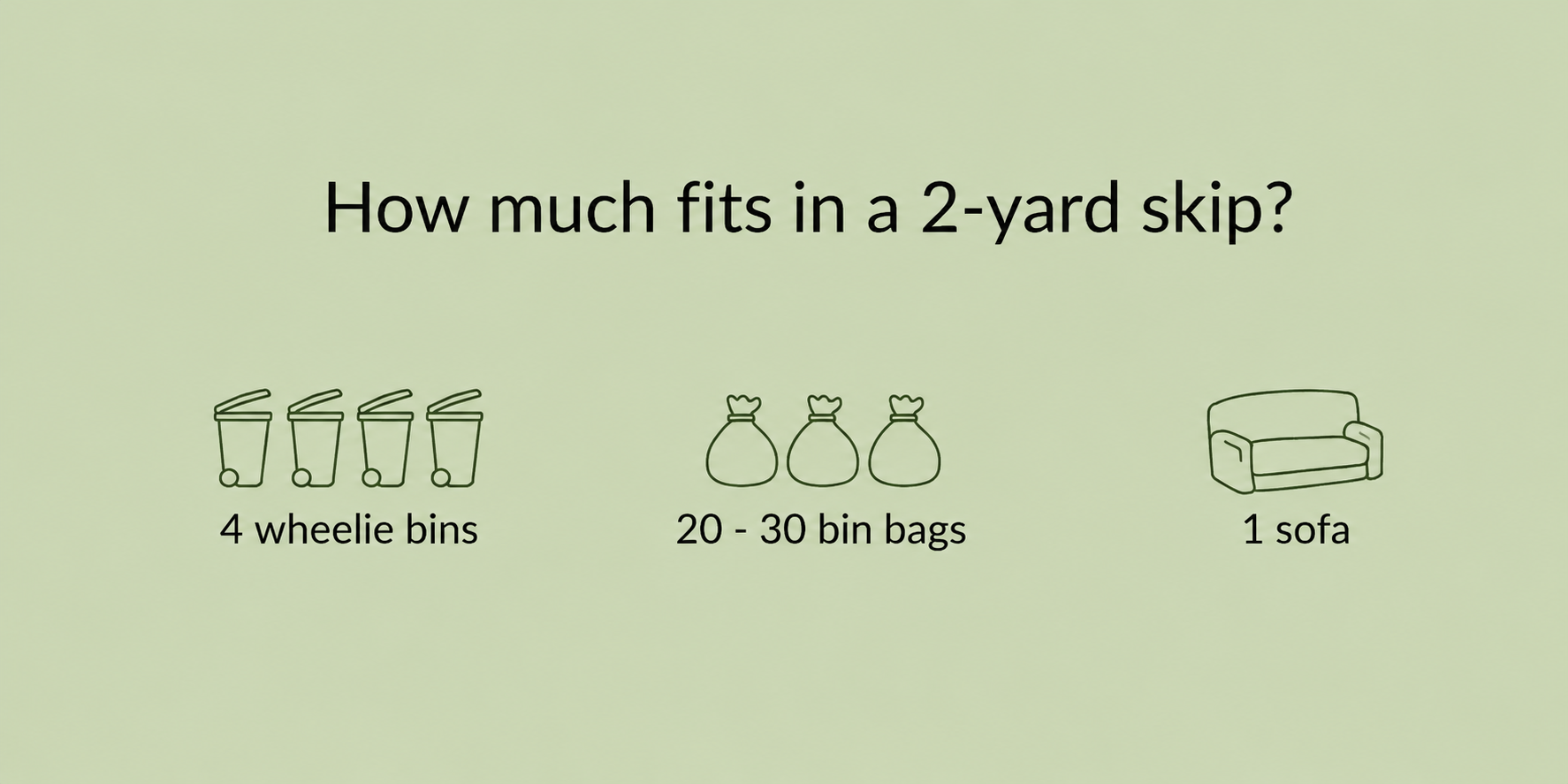
Approximate capacity
2 tonnes
20–30 bin bags
4 wheelie bins
Typical dimensions
Height: 0.9m
Length: 1.2m
Width: 1m
Good to know
Mini skips are particularly useful for dense heavy waste because larger skips can become overweight very quickly.
They are also the cheapest, so if you want to keep costs down, hiring one might be the perfect solution. However, bear in mind that if you get it wrong, the cost of ordering another skip will outweigh the cost of using a 4-yard skip in the first place.
4 Yard Midi Skip
A 4 yard is a small skip that is widely used by installers of bathrooms because it is the perfect size to hold an old bathroom and other DIY improvements.
Best for:
Bathroom renovations
Small kitchen refits
Furniture disposal
General household waste
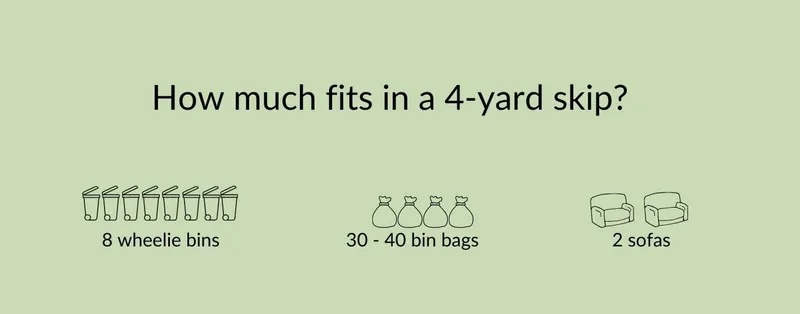
Approximate capacity
30–40 bin bags
8 wheelie bins
Typical dimensions
Height: 1m
Length: 1.8m
Width: 1.3m
What fits in a 4 yard skip?
Typically:
bathroom suites
carpets
tiles
furniture
DIY waste
This is one of the most practical domestic skip sizes because it fits comfortably on many driveways. But it is important to remember that skips arrive on a lorry and, no matter how small the skip is itself, the lorry will always require space to unload it and manoeuvre.
6 Yard Builders Skip
The 6 yard skip is called the 'builders skip' is one of the most commonly hired in the UK.
Best for:
Kitchen renovations
Medium-sized building projects
Garage and loft clearances
Mixed builders waste
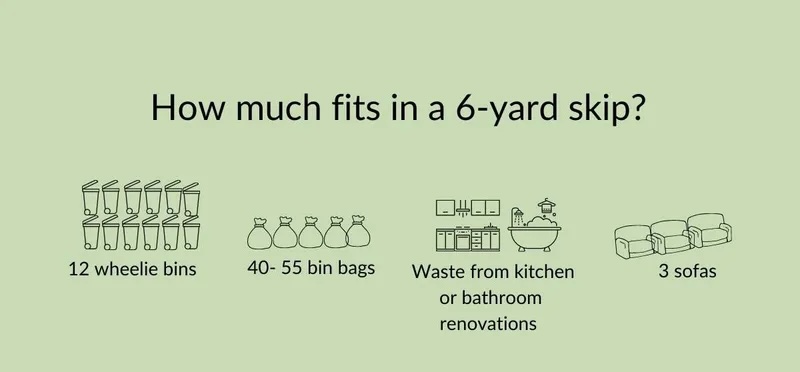
Approximate capacity
40–55 bin bags
12 wheelie bins
Typical dimensions
Height: 1.2m
Length: 2.6m
Width: 1.5m
Why is it called a builders skip?
The 6 yard skip is one of the most commonly hired skips in the UK because it balances:
capacity
cost
road suitability
weight handling
It is large enough for renovation projects but still manageable for domestic properties.
Also, councils generally do not allow skips of any larger size on the road, so that is why hiring builders skip is so popular.
8 Yard Builders Skip
8 yard skips are also referred to as a 'builders skip' but is the larger of the two.
Best for:
Major renovations
Full house clearances
Landscaping projects
Bulky waste disposal
Approximate capacity
60–80 bin bags
16 wheelie bins
Typical dimensions
Height: 1.2m
Length: 3.7m
Width: 1.7m
Important
8 yard skips are often the largest skips suitable for heavy construction waste such as:
rubble
bricks
concrete
soil
Larger skips can become too heavy for transport vehicles when filled with dense waste.
12 Yard Maxi Skip
Maxi skips are a huge 12-yard skip and are usually only used for commercial projects as councils do not allow them to be placed on a road.
Best for:
Commercial projects
Office clearances
Bulky lightweight waste
Large volumes of packaging
Approximate capacity
100–120 bin bags
24 wheelie bins
Typical dimensions
Height: 1.7m
Length: 3.7m
Width: 1.8m
Important restriction
12 yard skips are generally NOT suitable for:
soil
rubble
concrete
These materials are too heavy for large skips when fully loaded.
What Skip Size Do I Need?
Choose a 2 yard skip if:
you have a small amount of heavy waste
you are disposing of soil or rubble
space is very limited
Choose a 4 yard skip if:
you are replacing a bathroom
disposing of furniture
doing smaller home improvements
Choose a 6 yard skip if:
you are renovating a kitchen
removing builders waste
clearing a garage or loft
Choose an 8 yard skip if:
you are clearing an entire house
completing major renovations
disposing of bulky waste
Choose a 12 yard skip if:
you are handling commercial waste
disposing of lightweight bulky materials
clearing offices or retail premises
How Much Does Skip Hire Cost?
Skip hire prices vary depending on:
skip size
location
waste type
hire duration
whether a road permit is required
As a general guide, expect to pay:
Skip Size | Average UK Hire Cost |
|---|---|
2 Yard Skip | £90–£200 |
4 Yard Skip | £190–£250 |
6 Yard Skip | £220–£300 |
8 Yard Skip | £240–£350 |
12 Yard Skip | £270–£450 |
Heavy waste such as rubble, soil and concrete may increase disposal costs.
Skip hire is also usually more expensive in:
London
the South East
cities with limited access or high disposal fees
For a more detailed breakdown of regional skip prices, permits and ways to save money, see our complete Skip Price Guide.
What Cannot Go in a Skip?
Some items cannot normally be placed in standard skips, including:
asbestos
tyres
batteries
fridges and freezers
televisions and monitors
hazardous chemicals
Some skip companies may also charge extra for:
mattresses
plasterboard
electrical appliances
Always check restrictions before hiring a skip.
For a full breakdown of prohibited waste and skip hire rules, see our Complete Skip Hire Guide.
Alternatives to skip hire
Skip hire is not always the best option for every project.
Depending on the type and amount of waste, alternatives may include:
man and van waste removal
skip bags and Hippo bags
household recycling centres
For a full comparison of skip hire alternatives, costs and when each option is best, see our Complete Skip Hire Guide.
Final Thoughts
Choosing the correct skip size is one of the most important parts of any waste removal project.
For most domestic renovations:
4 yard and 6 yard skips are ideal
For major renovations:
8 yard skips are usually best
For bulky commercial waste:
12 yard maxi skips are the preferred option
If you are unsure between two sizes, it is usually safer to choose the slightly larger skip.
Related Guides
Frequently Asked Questions
What is the most popular skip size?
The 6 yard builders skip is one of the most commonly hired skips in the UK.
What size skip do I need for a bathroom renovation?
Usually a 4 yard skip is sufficient for a standard bathroom refit.
What size skip is best for rubble?
Usually:
2 yard skips
4 yard skips
6 yard skips
Heavy waste should not normally be placed in very large skips.
Can I mix waste types in a skip?
Usually yes, although hazardous waste and certain restricted items are prohibited.
Can I put plasterboard in a skip?
Usually yes, but many skip companies require it to be separated because of disposal regulations.
Do I need a permit for a skip?
Only if the skip is placed on a public road or pavement.
How long can I keep a skip?
Most skip hire periods are between 7 and 14 days.
Related Articles
DIY & Rubble Disposal Guide UK
Last updated: May 2026 Estimated reading time: 8 minutes DIY projects and home renovations can creat...

Skip Hire vs Private Waste Collection
Last updated: March 2026 When you need to dispose of bulky, renovation or construction waste, two of...

How to Dispose of Old Carpet in the UK
Last updated: May 2026 Getting rid of old carpet, underlay, rugs or flooring waste? This guide expla...